How Accredited Programs Build Employer Trust Across Borders

Global business has changed dramatically over the past decade. Organizations are no longer recruiting exclusively from local talent pools, and professionals are increasingly building careers that span multiple countries, cultures, and industries. As this global workforce continues to expand, one challenge has become increasingly important: How can employers confidently evaluate qualifications earned in different parts of the world?
The answer lies in accreditation.
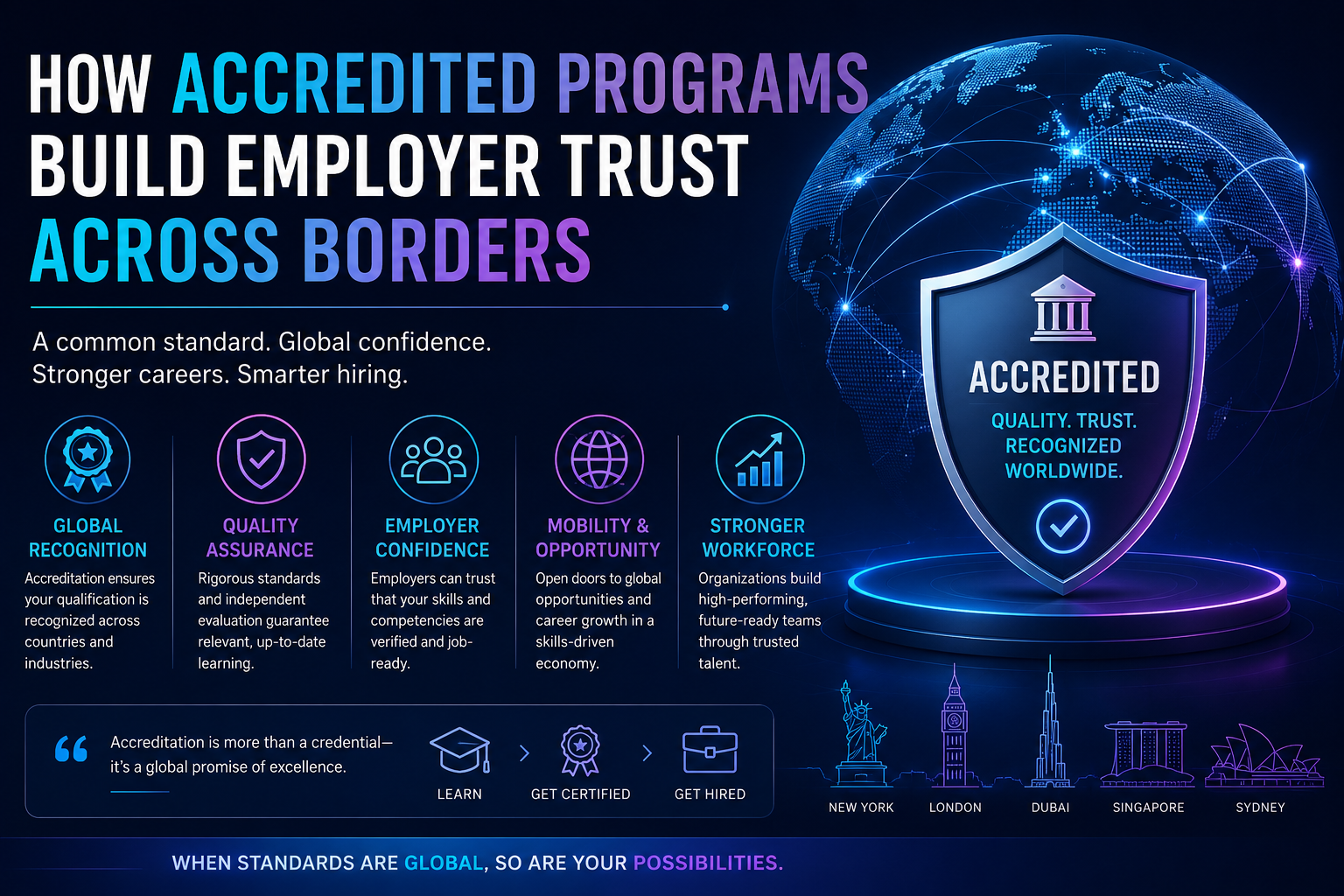
Accredited education and certification programs provide a common benchmark for quality, competence, and integrity. They help employers move beyond unfamiliar institutions, varying educational systems, and inconsistent credentials by providing confidence that a qualification has been developed, delivered, and assessed against recognized standards.
The Challenge of a Global Workforce
Today’s organizations hire remotely, manage international teams, and expand into new markets faster than ever before. A project team may include professionals from Europe, Asia, the Middle East, Africa, and North America, each bringing qualifications earned under different educational frameworks.
While diversity strengthens organizations, it also creates a practical challenge for hiring managers and HR leaders.
Questions naturally arise:
- How rigorous was the assessment?
- Were the competencies independently verified?
- Does this qualification reflect current industry expectations?
- Can the credential be trusted regardless of where it was earned?
Without a consistent framework, comparing qualifications becomes difficult and increases recruitment risk.
Why Trust Has Become the Most Valuable Credential
Technical knowledge alone is no longer sufficient. Organizations are making decisions that involve cybersecurity, artificial intelligence, digital transformation, sustainability, healthcare, finance, and other critical domains where mistakes can carry significant consequences.
Employers therefore seek evidence that professionals possess not only knowledge, but also validated competence, ethical awareness, and a commitment to continuous professional development.
Accredited programs help establish this confidence because they demonstrate that learning outcomes, assessment methods, governance practices, and quality assurance processes have been independently evaluated.
Rather than asking employers to simply “believe” a qualification has value, accreditation provides objective evidence that supports that belief.
Accreditation Creates a Common Language
One of the greatest strengths of accreditation is its ability to create consistency across different education and certification systems.
Although countries may have different academic structures, professional standards, and regulatory environments, accredited programs operate using clearly defined principles of quality, transparency, and accountability.
This consistency allows employers to focus less on where a credential was earned and more on what competencies it represents.
For multinational organizations, this reduces uncertainty during recruitment and creates greater confidence in workforce planning.
Reducing Hiring Risk
Recruitment is one of the largest investments an organization makes. Every hiring decision carries financial, operational, and cultural implications.
When organizations recruit professionals who hold qualifications from accredited programs, they gain greater confidence that candidates have been evaluated using structured and reliable assessment processes.
Accreditation supports hiring by helping employers:
- Verify professional competence
- Reduce uncertainty during candidate evaluation
- Improve consistency across recruitment decisions
- Strengthen workforce quality
- Support compliance with organizational competency frameworks
Rather than replacing interviews or practical assessments, accredited qualifications provide an additional layer of assurance that helps employers make better-informed decisions.
Supporting International Mobility
Professional mobility has become a defining characteristic of today’s workforce.
Engineers work across continents. Healthcare professionals relocate internationally. IT specialists collaborate with global teams. Consultants serve clients in multiple jurisdictions.
In this environment, professionals benefit significantly when their qualifications are supported by internationally recognized accreditation.
Accredited programs make it easier for employers, clients, and professional bodies to understand the quality and scope of an individual’s competencies without needing extensive additional verification.
This does not eliminate country-specific licensing or regulatory requirements, but it provides a stronger foundation upon which professional recognition can be built.
Building Organizational Confidence
The benefits of accreditation extend beyond recruitment.
Organizations that encourage employees to pursue accredited certifications often experience improvements in several areas:
- Greater confidence in workforce capability
- More consistent professional development pathways
- Stronger alignment with industry best practices
- Increased customer confidence
- Enhanced organizational credibility
Clients and stakeholders increasingly ask about the qualifications of the professionals delivering products and services. Accredited credentials provide organizations with tangible evidence of workforce quality.
Accreditation Supports Lifelong Learning
One of the most important characteristics of modern professional development is that it never truly ends.
Technology evolves. Regulations change. Customer expectations shift. New industries emerge.
Accredited programs recognize that professional competence must be maintained rather than assumed. Many accreditation frameworks encourage ongoing learning through continuing professional development, competency reviews, and periodic renewal processes.
This emphasis on continuous improvement benefits both professionals and employers by ensuring that knowledge remains current and relevant.
Ethics and Professional Responsibility
Trust is built not only through technical competence but also through ethical practice.
Many accredited programs integrate professional ethics, governance, accountability, and responsible decision-making into their competency frameworks.
This reflects an important reality of today’s workplace: organizations expect professionals to make decisions that balance technical expertise with integrity and social responsibility.
Professionals who understand both competence and ethics contribute to stronger organizational cultures and more sustainable business outcomes.
The Role of Independent Accreditation
The credibility of any accreditation system depends on independence.
When accreditation is conducted by impartial organizations operating under transparent standards, employers can have greater confidence that certifications are not influenced by commercial interests or inconsistent assessment practices.
Independent accreditation bodies help maintain:
- Consistent quality standards
- Transparent governance
- Objective evaluation processes
- Continuous monitoring and improvement
- Public confidence in professional credentials
Their role is essential in preserving the long-term value of accredited qualifications.
Looking Ahead
As organizations continue to expand globally, the demand for trusted, portable, and standards-based credentials will only increase.
Artificial intelligence, digital transformation, cybersecurity, sustainability, and emerging technologies are creating new professional roles that require continuous validation of competence.
Accredited programs provide a framework that supports this evolution by ensuring that qualifications remain credible, relevant, and internationally respected.
For employers, accreditation simplifies talent evaluation.
For professionals, it strengthens career mobility.
For industries, it promotes consistency, quality, and trust.
Conclusion
Trust is one of the most valuable assets in today’s global workforce.
Accredited programs help build that trust by providing independent assurance that professional qualifications meet recognized standards of quality, competence, and integrity.
As organizations navigate an increasingly interconnected world, accreditation serves as a bridge between education, professional capability, and employer confidence.
In a global economy where opportunities increasingly cross borders, accredited qualifications do more than validate learning—they help build trust that travels with the professional, wherever their career takes them.