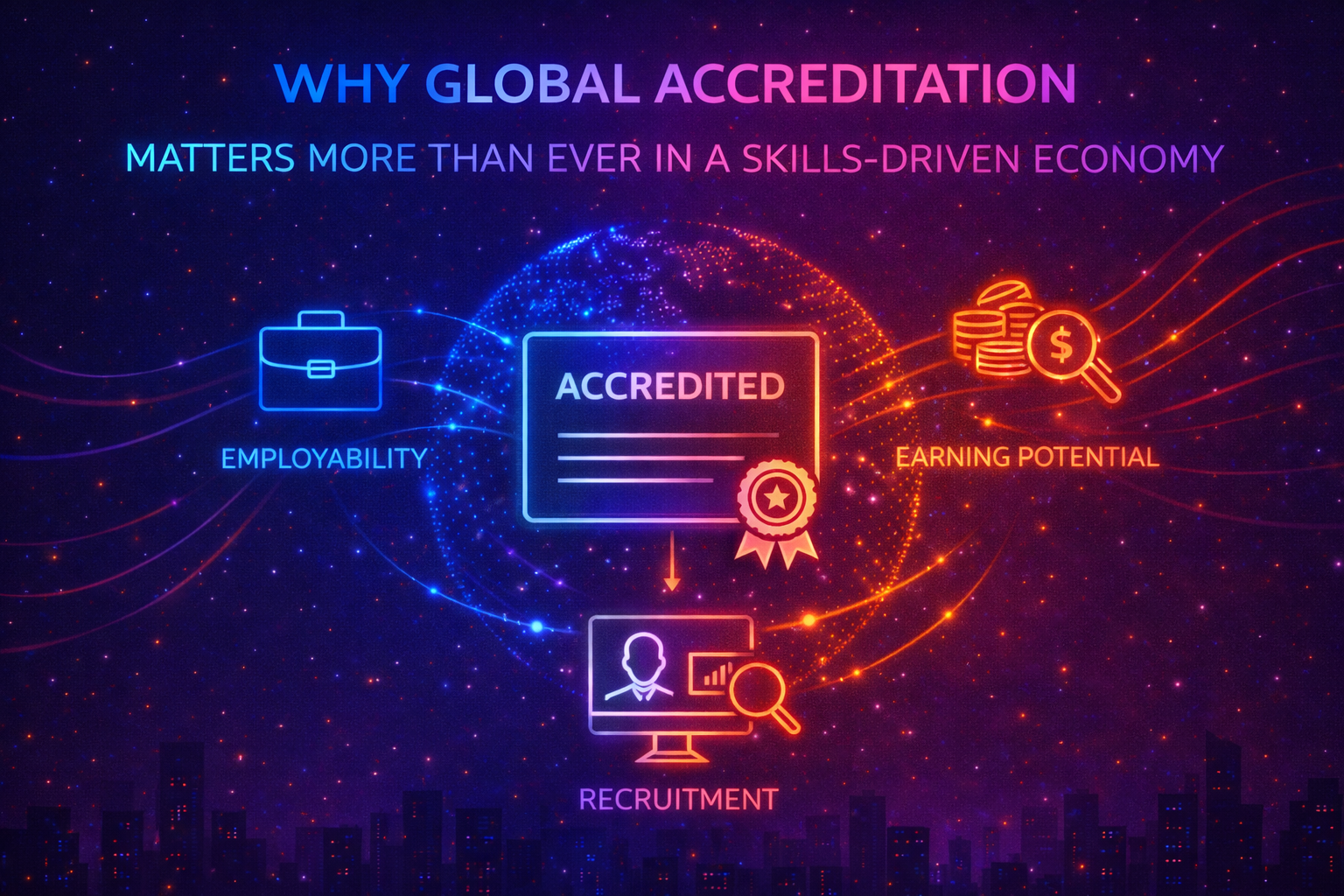
Why Global Accreditation Matters More Than Ever in a Skills-Driven Economy

In today’s economy, qualifications alone are no longer enough. Degrees open doors, but verified competencies build trust. As industries evolve faster than ever before, employers are no longer just asking “Where did you study?” They are asking “What can you do, and who has validated it?”
This shift has made global accreditation more important than at any other time in modern workforce history.
The Shift from Degrees to Demonstrated Competence
For decades, academic qualifications were the primary benchmark of capability. While degrees remain valuable, they often represent theoretical knowledge at a fixed point in time. The modern workplace, however, demands adaptability, practical competence, and continuous skill enhancement.
Digital transformation, automation, and globalized workforces have redefined what “qualified” truly means. Employers now prioritize:
- Practical, job-ready skills
- Verified competencies aligned with industry standards
- Continuous professional development
- Globally recognized credentials
In a skills-driven economy, competence must be measurable and validated against recognized benchmarks. This is where accreditation becomes critical.
Accreditation vs Certification: Understanding the Difference
It is important to distinguish between a certificate and accredited certification.
A certificate may simply confirm attendance or course completion. An accredited certification, however, validates that a program or professional meets internationally recognized standards, assessed through independent and structured evaluation.
Global accreditation ensures:
- The assessment process is objective and impartial
- Standards align with industry and international benchmarks
- The credential carries credibility beyond local recognition
- Employers can trust the quality and rigor behind the qualification
Without accreditation, certification risks becoming inconsistent, subjective, or commercially driven rather than standards-driven.
Why Employers Demand Accredited Credentials
Organizations today operate across borders. Talent mobility is global. A professional in Prague may collaborate with teams in Dubai, Singapore, or Toronto.
In such an environment, employers rely on accreditation to reduce hiring risk. Accredited certifications provide assurance that:
- Competency standards are consistent across regions
- Assessments are conducted fairly and transparently
- Professional development is structured and monitored
- Ethics and governance principles are embedded in certification processes
Accreditation transforms credentials from marketing claims into trusted professional benchmarks.
Global Standards and Workforce Confidence
When certification bodies follow internationally recognized frameworks such as ISO-based guidelines for professional certification, they signal something powerful: independence, quality assurance, and global alignment.
Standards-driven accreditation promotes:
- Transparency in assessment criteria
- Continuous monitoring and improvement
- Accountability of certification providers
- Confidence among employers and institutions
This framework strengthens the ecosystem of training providers, professionals, and employers alike.
The Role of Independent Accreditation Bodies
Independent accreditation councils play a pivotal role in maintaining the integrity of the professional certification landscape.
Their responsibilities include:
- Evaluating training providers against defined standards
- Ensuring assessment validity and reliability
- Monitoring compliance and governance practices
- Protecting stakeholder interests through transparent oversight
In a rapidly expanding credential marketplace, independent accreditation acts as a safeguard against diluted standards.
Employability in a Skills-Driven Era
Today’s professionals are expected to demonstrate both technical expertise and soft skills such as leadership, communication, adaptability, and ethical judgment.
Accredited programs help professionals:
- Align their competencies with industry needs
- Enhance credibility in competitive job markets
- Build a structured pathway for career progression
- Engage in lifelong learning with recognized milestones
For organizations, investing in accredited certification programs strengthens workforce capability and enhances brand reputation.
Lifelong Learning as a Strategic Imperative
The half-life of skills continues to shrink. Continuous professional capacity enhancement is no longer optional; it is a necessity.
Accredited frameworks encourage structured professional development through:
- Ongoing skill assessment
- Professional development credit systems
- Renewal and recertification requirements
- Engagement in thought leadership and networking platforms
This ensures that certification represents not only past achievement but ongoing competence.
Building a Culture of Trust and Excellence
Global accreditation fosters a culture where quality, ethics, and professionalism are not marketing slogans but operational standards.
Organizations that align with accredited certification frameworks demonstrate:
- Commitment to global excellence
- Integrity in validation processes
- Transparency in governance
- Dedication to sustainable professional growth
Such alignment benefits professionals, employers, and the broader industry ecosystem.
Looking Ahead
As economies transition from knowledge-based to skills-driven models, the demand for trustworthy, globally recognized credentials will continue to rise.
Accreditation is not merely an administrative process. It is the foundation of professional credibility in a global marketplace.
In a world where skills define opportunity, global accreditation ensures that competence is recognized, validated, and respected across borders.
For professionals seeking meaningful career progression and organizations committed to excellence, accreditation is not an option. It is a strategic necessity.