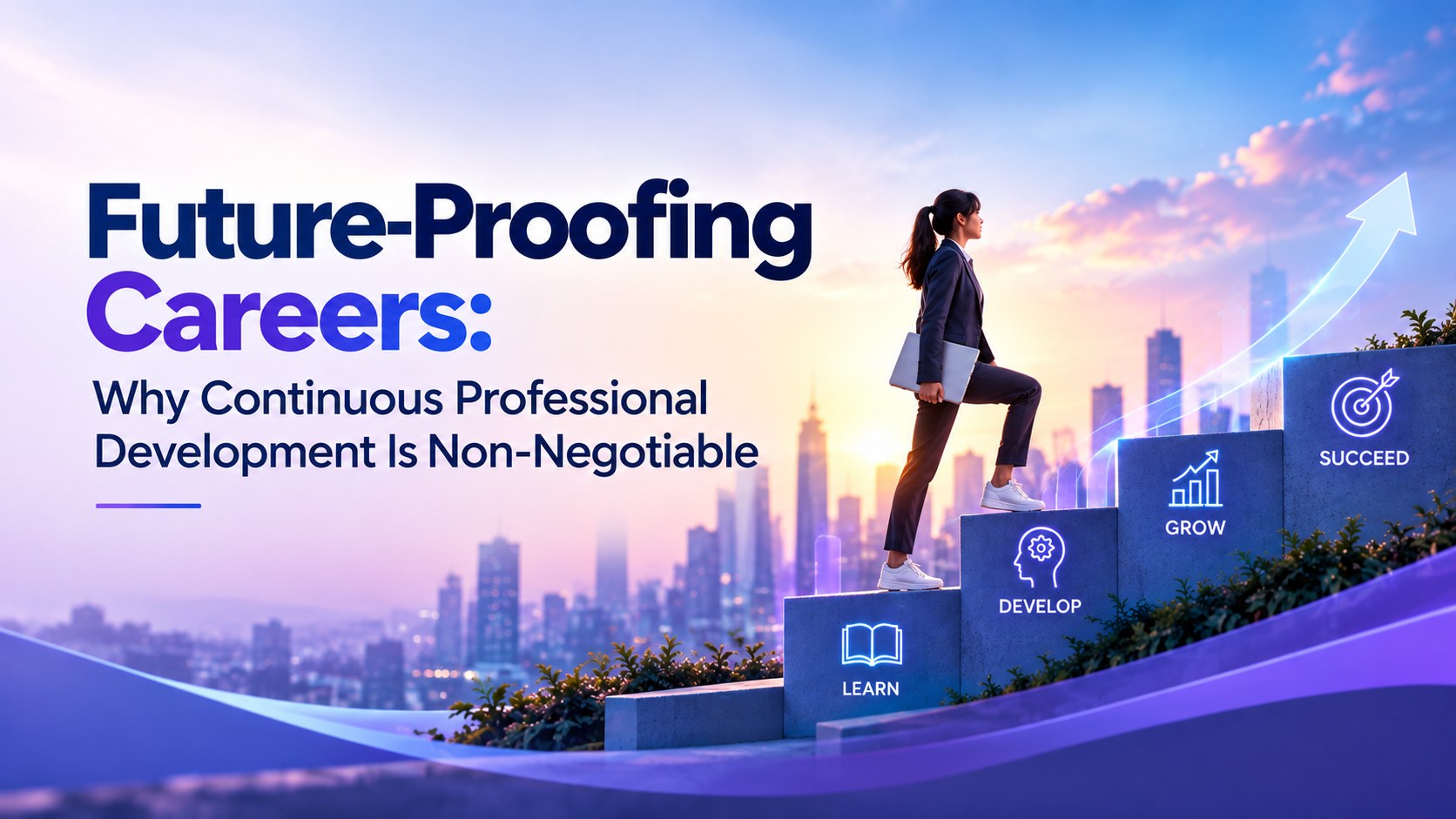
Future-Proofing Careers: Why Continuous Professional Development Is Non-Negotiable

Career security increasingly depends not only on what you know today, but on how effectively you continue learning tomorrow.
A qualification may help someone enter a profession. Experience may help them progress. But neither guarantees that their skills will remain relevant indefinitely.
The modern workplace changes too quickly for professional development to stop at graduation, certification, or promotion.
Artificial intelligence is altering workflows. Cybersecurity threats are evolving. Regulations are changing. Sustainability requirements are reshaping industries. New tools are reducing the lifespan of existing technical knowledge, while employers are placing greater value on adaptability, analytical thinking, leadership, communication, and problem-solving.
That is why Continuous Professional Development, or CPD, is becoming a core part of long-term employability.
The Skills That Built a Career May Not Sustain It
The idea of learning one profession and relying on the same knowledge for an entire career is disappearing.
The World Economic Forum's Future of Jobs Report 2025 found that employers expect approximately 39% of workers' existing core skills to change or become outdated by 2030. The same research estimates that, if the global workforce were represented by 100 people, 59 would require training by 2030.
LinkedIn's 2025 Work Change Report presented an even broader view of workplace transformation, estimating that 70% of the skills used in most jobs could change by 2030, with artificial intelligence acting as one of the major accelerators.
These forecasts do not mean that today's expertise suddenly becomes useless. They mean something more important: professionals must expect their roles to evolve.
An accountant may increasingly need data-analysis capability. A project manager may need to understand AI-assisted planning. A cybersecurity professional may need stronger business-risk and governance skills. A marketer may need to work with automation, analytics, and AI while retaining creativity, judgement, and customer understanding.
Career development is therefore becoming less about periodically acquiring a new qualification and more about maintaining an evolving portfolio of competencies.
CPD Is More Than Attending Courses
Continuous Professional Development is sometimes misunderstood as simply attending training every year. Effective CPD is broader.
It includes any structured activity that helps a professional maintain, improve, or expand the competencies required for their current or future responsibilities.
- Formal courses and professional certifications
- Workshops and conferences
- Mentoring and coaching
- Industry research and independent study
- Practical projects
- Professional communities and knowledge sharing
- Leadership assignments
- Teaching or mentoring others
- Technical or professional writing
- Reflecting on workplace experience
- Learning emerging technologies or regulations The value of CPD lies not in accumulating hours but in producing meaningful professional growth. Ten hours of training that changes how a professional performs their job may be more valuable than fifty hours of passive attendance.
Why Continuous Learning Has Become a Career Strategy
Continuous learning was once treated as an additional benefit. Today, it increasingly functions as a form of career risk management.
Consider what happens when an industry changes. Some professionals wait until their role is threatened before learning a new capability. Others identify the shift early, develop the necessary skills, and position themselves for the opportunities created by that change.
The difference is rarely intelligence. It is preparedness.
Professionals who consistently invest in development are better positioned to:
- Adapt when job responsibilities change
- Move into emerging roles
- Transition between industries
- Take on leadership responsibilities
- Respond to technological disruption
- Maintain professional credibility
- Demonstrate current competence to employers and clients Future-proofing a career does not mean predicting exactly what will happen. It means developing the ability to adapt when it does.
An Interesting Shift: Employers Want Technical and Human Skills Together
The rise of AI has created a common assumption that future careers will depend primarily on technical skills. Current workforce research suggests otherwise.
The World Economic Forum identifies AI and big data, cybersecurity, and technological literacy among the fastest-growing skills. But it also highlights analytical thinking, resilience, flexibility, leadership, creative thinking, curiosity, and lifelong learning as increasingly important capabilities.
The International Labour Organization has reached a similar conclusion in its work on lifelong learning, noting that employers increasingly require rounded skill profiles combining technical expertise with digital literacy, critical thinking, social abilities, and other foundational competencies.
This matters because technology frequently changes how work is performed without removing the need for human judgement.
A professional who knows how to use AI tools but cannot communicate, evaluate risk, collaborate, or exercise judgement may still struggle. Likewise, strong interpersonal skills without current technical competence may limit career progression.
The future professional therefore needs both.
Learning Should Continue After Certification
Professional certification is an important milestone, but it should not represent the end of development.
A certification demonstrates competence at a particular stage of a professional's career. The environment around that competence continues changing.
This is why strong professional certification frameworks often include continuing education, professional development points, renewal requirements, or recertification.
These mechanisms serve an important purpose. They help transform certification from a one- time achievement into an ongoing commitment to professional competence.
For professionals, that means asking:
What has changed in my field since I earned this credential?
What capabilities will I need next?
What evidence can I provide that my knowledge remains current?
Those questions are more valuable than simply asking when a certificate expires.
The Learning Gap Is Becoming a Professional Risk
Despite the growing importance of lifelong learning, participation remains uneven.
OECD research shows that adults who are already highly educated or working in stronger employment positions are often more likely to participate in further learning, while workers who may benefit most from upskilling can have less access to it. The OECD's Skills Outlook 2025 reported participation in non-formal training of about 62% among adults in high-status occupations, compared with only 19% among adults with below upper-secondary education.
The OECD has also warned that barriers such as time, cost, awareness, employer support, and access continue to prevent adults from participating in training.
This creates a troubling cycle. Those already positioned for opportunity keep developing. Those who need new skills most urgently risk falling further behind.
Organizations therefore have a responsibility as well. Building a learning culture should not mean providing development only to senior managers or high-potential employees. It should create realistic opportunities for employees across different roles and career stages to remain relevant.
CPD Should Be Intentional, Not Random
Another challenge is what might be called learning without direction.
Professionals see an emerging topic, take a course, collect a badge, move to another subject, and repeat. They may be learning continuously without actually building a stronger career.
Effective CPD should begin with a simple question: What capability am I trying to build, and why does it matter?
1. Current-role competence What skills are necessary to perform the present job at a higher level?
2. Emerging industry capability What technologies, regulations, methods, or trends are likely to affect the profession?
3. Transferable professional skills What capabilities remain valuable regardless of role – communication, leadership, analytical thinking, decision-making, ethics, collaboration?
4. Career-direction skills If the professional wants to move into management, consulting, specialization, entrepreneurship, or another function, what new competencies will be required?
CPD becomes far more powerful when learning activities map to these objectives.
From Learning Hours to Learning Outcomes
Organizations and professionals also need to reconsider how professional development is measured.
Counting training hours is easy. Measuring improvement is harder – but more meaningful.
Instead of asking only, "How many CPD hours did you complete?" consider asking:
- What new capability did you develop?
- Where have you applied it?
- What improved as a result?
- What evidence demonstrates the learning?
- What capability should be developed next? A cybersecurity professional who studies cloud security and then helps redesign an organization's cloud controls has demonstrated development. A manager who completes leadership training and subsequently improves team feedback practices has applied learning. A project professional who studies AI-assisted project management and introduces a more effective planning workflow has converted knowledge into capability.
Professional development becomes valuable when learning changes performance.
Employers Have a Role in Career Future-Proofing
Continuous development cannot rest entirely on employees. Organizations benefit directly from maintaining a workforce that can adapt.
The World Economic Forum reports that half of workers represented in its employer survey had already completed training, reskilling, or upskilling initiatives as part of long-term workforce strategies – up from 41% in its previous edition.
Progressive organizations increasingly treat workforce development as a strategic investment rather than a training expense.
Practical approaches include:
- Defined learning pathways for different roles
- Professional certification support
- Mentoring programs
- Internal mobility opportunities
- Learning budgets
- Protected development time
- Cross-functional assignments
- Recognition of professional development achievements The strongest learning cultures connect employee growth with organizational capability. Employees see how development advances their careers. Organizations see how it supports business performance.
A Simple Annual CPD Framework for Professionals
Continuous development does not need to become complicated. A practical yearly plan could include five steps.
Step 1: Assess Identify current strengths, gaps, and future requirements.
Step 2: Prioritize Choose two or three competencies that will materially improve your professional capability.
Step 3: Learn Select appropriate courses, certifications, mentoring, projects, or independent study.
Step 4: Apply Find opportunities to use the new skills in actual professional situations.
Step 5: Reflect and Record Document what changed, the results achieved, and what should be developed next.
Assess -> Learn -> Apply -> Reflect -> Improve That cycle is the real foundation of lifelong professional development.
The Career Advantage of Curiosity
Perhaps one of the most underestimated professional skills is curiosity.
The ability to ask questions, explore unfamiliar topics, reconsider established practices, and learn independently becomes increasingly valuable when industries change rapidly.
This may explain why the World Economic Forum specifically identifies curiosity and lifelong learning among skills expected to rise in importance toward 2030.
Curious professionals rarely wait for their employer to tell them that something has changed. They notice the change themselves. They investigate it. They learn. And they adapt.
That behaviour can become one of the strongest forms of career resilience.
Conclusion
No organization can guarantee lifetime employment. No qualification can guarantee lifetime relevance. And no professional can know precisely how their industry will evolve over the next decade.
What professionals can control is their capacity to keep developing.
Continuous Professional Development provides a structured way to maintain competence, respond to new technologies, strengthen professional credibility, and prepare for opportunities that may not yet exist.
For organizations, it builds a more adaptable and resilient workforce. For professionals, it turns learning into a long-term career strategy.
The professionals most prepared for the future will not necessarily be those who know the most today. They will be those who have developed the habit, discipline, and curiosity to keep learning when tomorrow demands something different.
Selected References
- World Economic Forum – Future of Jobs Report 2025
- LinkedIn – Work Change Report 2025
- International Labour Organization – Lifelong Learning and Skills for the Future
- OECD – Skills Outlook 2025: How Learning Evolves Across the Life Course
- OECD – Helping Adults Overcome Barriers to Training