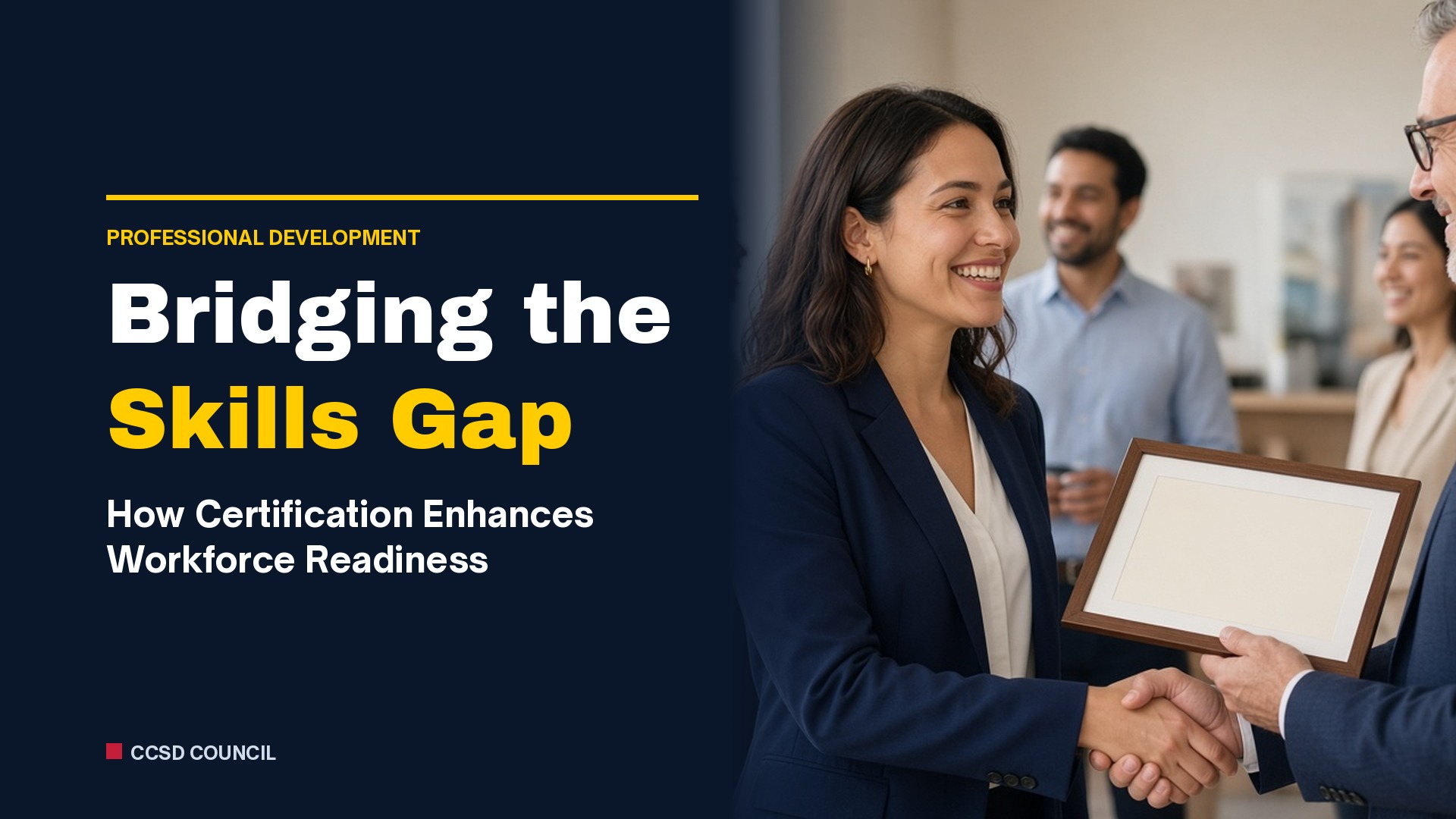
Bridging the Skills Gap: How Certification Enhances Workforce Readiness

Evidence from the World Economic Forum, OECD, LinkedIn, McKinsey and the ILO points the same way. Closing the skills gap takes more than training. Skills also need to be visible, verifiable and trusted, and that is the job of credible certification and structured continuous professional development (CPD).
Introduction: A Readiness Problem, Not Just a Training Problem
The “skills gap” usually gets described as a shortage of people with the right abilities. That is only part of it. Many organisations also struggle to see which skills their people already have, to judge whether new hires can do what their CVs say, and to keep up as job requirements change.
At CCSD Council, we treat the skills gap as a workforce readiness problem. Readiness depends on three things: having the right skills, being able to show them, and having them recognised by employers. Training builds the first. Independent, quality-assured certification and well-documented CPD help with the second and third.
What the Evidence Shows
Skills gaps are the top barrier to transformation
The World Economic Forum’s Future of Jobs Report 2025 found that 63% of employers see skills gaps as the main barrier to business transformation over 2025–2030, up from 60% in the 2023 edition. Skills gaps ranked first in 52 of the 55 economies surveyed and in 19 of 22 sectors. Only 29% of businesses expect talent availability to improve over the period, down from 39% in 2023.
The skills jobs require keep changing
According to the same report, employers expect 39% of workers’ core skills to change or become outdated by 2030. LinkedIn’s Work Change Report (2025) gives a higher estimate: it expects 70% of the skills used in most jobs to change by 2030, with AI speeding things up. The two figures measure different things, but the conclusion is the same. A qualification earned at the start of a career will not cover all of it.
The WEF puts the scale of the response in simple terms. If the world’s workforce were 100 people, 59 would need training by 2030. Employers expect 29 of them to be upskilled in their current roles and 19 to be reskilled and moved to other roles. The other 11 are unlikely to get the training they need.
Many workers are already mismatched
The gap is not only about the future. The OECD’s Survey of Adult Skills 2023 (PIAAC) found that about one-third of workers across OECD countries are mismatched to their jobs by qualifications, skills or field of study. On average, 10% of workers say they are under-skilled for their current role, and they most often point to digital skills as the area they need to improve.
Organisations have known this for years
The problem is not new. In a 2019 McKinsey Global Survey, 87% of executives and managers said their organisations already had skill gaps or expected them within five years. In the WEF’s 2025 survey, 85% of employers said they plan to prioritise upskilling their workforce.
Why Certification Matters for Readiness
Training on its own does not solve the problem. A course can build a skill, but if nobody can check what was learned, to what standard and how recently, employers have little to go on. Certification fills that gap in four ways.
1. It makes skills visible
Employers are moving towards skills-based hiring. LinkedIn’s Economic Graph research (2025) found that hiring on skills rather than past job titles could expand talent pools by 6.1 times globally. That only works when skills can be clearly identified. A certification tied to defined learning outcomes gives a clear signal that a skill is there.
2. It makes skills verifiable
The International Labour Organization (ILO) describes good recognition systems as ones that identify, assess and certify a person’s competencies against set standards, issued by an authorised body. That covers skills learned on the job or informally, not only in a classroom. The ILO notes that this lets employers get proof of skilled personnel and match people to jobs more accurately.
3. It builds trust through quality assurance
Not all credentials carry the same weight. The OECD’s International Review of Micro-Credential Systems (2026) found that employers and learners are more likely to value credentials issued by trusted institutions and checked by an external quality assurance body. It also found that credentials co-designed or endorsed by industry are more credible in the labour market. Independent accreditation is what turns a certificate into a signal employers can rely on.
4. It makes skills portable
Recognised standards let skills move between employers, sectors and countries. The ILO links skills recognition directly to employability, mobility and lifelong learning. This matters more as careers get less linear: LinkedIn reports that people entering the workforce today are on track to hold twice as many jobs over their careers as those who started 15 years ago.
Where Structured CPD Fits
Certification shows what a professional can do at a given point. Structured CPD keeps that true as requirements change. Taken together, they give a readiness record that stays current. CCSD Council recommends that development be:
- Aligned: linked to a defined role, competency framework or skills standard
- Assessed: checked against stated learning outcomes, not just attendance
- Accredited: delivered or validated by bodies subject to independent quality assurance
- Accumulated: recorded over time so that short units add up to a coherent profile
A Practical Framework: The Readiness Cycle
CCSD Council suggests a four-stage cycle that professionals and employers can use together.
Stage 1: Map
- Compare current skills with the requirements of the current role and the next one.
- Use job descriptions, competency frameworks and labour-market data to find priority gaps.
Stage 2: Develop
- Pick structured, outcome-based learning that targets one or two priority gaps at a time.
- Mix formal learning with applied practice, mentoring and on-the-job projects.
Stage 3: Validate
- Choose independent, accredited certification where it exists for the skill area.
- Where skills were learned informally, look for recognition-of-prior-learning routes that can assess and certify them.
Stage 4: Renew
- Keep an up-to-date CPD record that links each credential to evidence of applied practice.
- Review the plan every year. Skill requirements change, so credentials need to be refreshed too.
For employers
- Hire on skills: write role requirements as competencies and accept credible certification as evidence alongside degrees and job history.
- Develop internally: fund accredited upskilling for current staff, since the WEF expects most workers who need training to be upskilled in their current roles.
- Check credential quality: favour certifications with transparent learning outcomes and independent quality assurance.
- Track the results: measure time-to-competence, internal mobility, retention and performance after certification.
Key Takeaways
- The gap is large and widespread. 63% of employers call skills gaps their main transformation barrier (WEF, 2025).
- Skills date quickly. Between 39% (WEF) and 70% (LinkedIn) of job skills are expected to change by 2030.
- Mismatch is already common. About one-third of OECD workers are mismatched to their jobs (OECD, 2024).
- Credibility counts. Employers trust quality-assured credentials from reputable issuers more (OECD, 2026).
- Readiness has to be maintained. Certification combined with structured CPD keeps capability current and visible.
Conclusion
The skills gap will not be closed by training volume alone. Professionals and organisations also need ways to show, verify and keep skills up to date. Independent, accredited certification gives skills a common standard that employers can trust. Structured CPD makes sure that standard keeps pace with changing work.
CCSD Council encourages professionals to treat certification as one part of a continuous development plan, not a one-off event. We encourage employers to recognise quality-assured credentials as real evidence of readiness.
Selected References
- World Economic Forum (2025). The Future of Jobs Report 2025, Chapter 3: Skills Outlook, and Chapter 4: Workforce Strategies. https://www.weforum.org/publications/the-future-of-jobs-report-2025/
- OECD (2024). Do Adults Have the Skills They Need to Thrive in a Changing World? Survey of Adult Skills 2023. https://www.oecd.org/en/publications/do-adults-have-the-skills-they-need-to-thrive-in-a-changing-world_b263dc5d-en.html
- OECD (2026). International Review of Micro-Credential Systems. https://www.oecd.org/en/publications/international-review-of-micro-credential-systems_bd913f1c-en/full-report/component-4.html
- LinkedIn (2025). Work Change Report: AI Is Coming to Work. https://news.linkedin.com/2025/work-change-report-2025
- LinkedIn Economic Graph (2025). Skills-Based Hiring: Increasing Access to Opportunity. https://economicgraph.linkedin.com/content/dam/me/economicgraph/en-us/PDF/skills-based-hiring-march-2025.pdf
- McKinsey & Company (2020). Beyond hiring: How companies are reskilling to address talent gaps. https://www.mckinsey.com/capabilities/people-and-organization/our-insights/beyond-hiring-how-companies-are-reskilling-to-address-talent-gaps
- International Labour Organization. Recognition of Prior Learning. https://www.ilo.org/recognition-prior-learning