

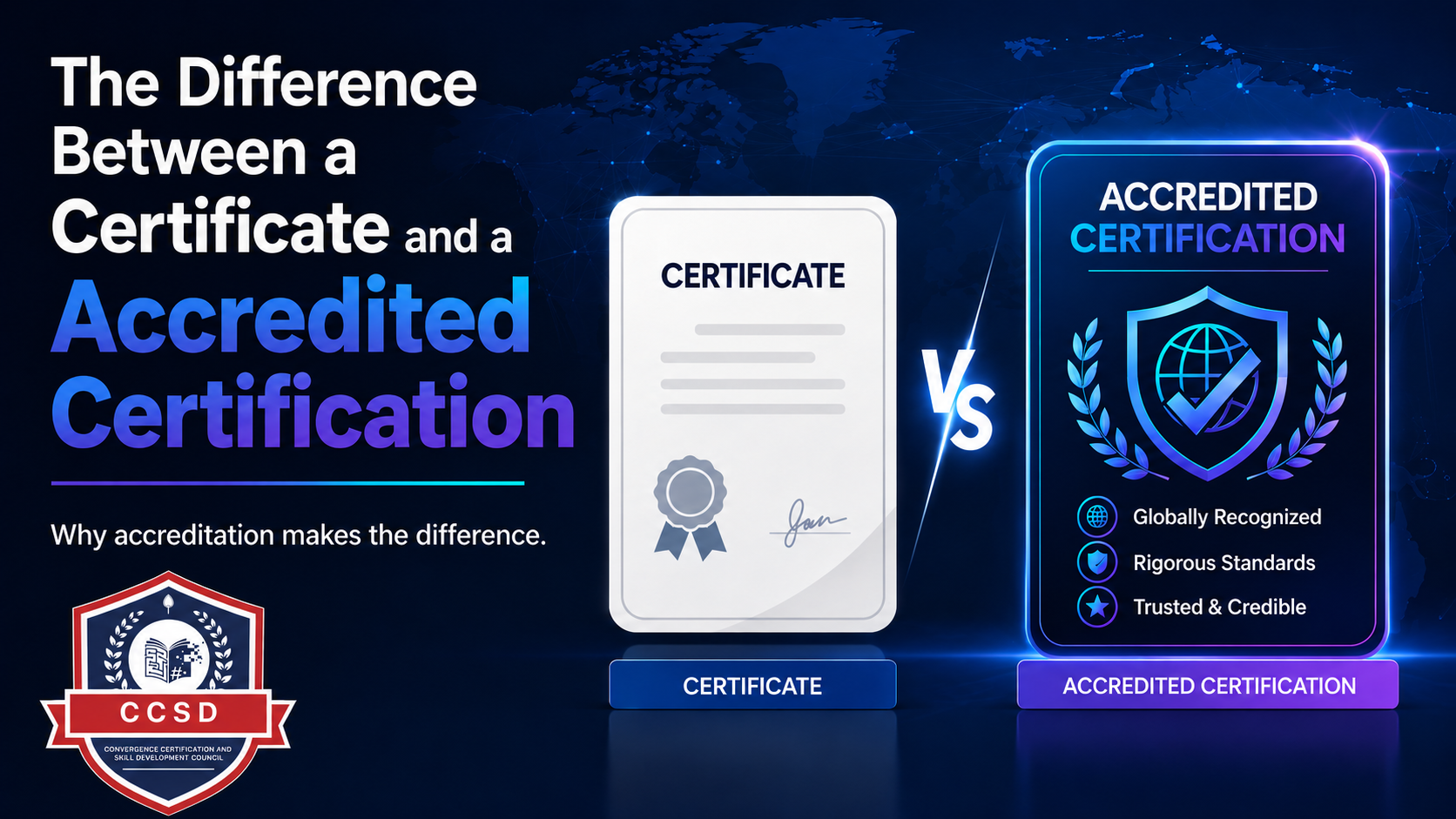
The Difference Between a Certificate and an Accredited Certification

Professional credentials have become an important part of career development. People use them to demonstrate learning, strengthen their résumés, support promotion opportunities, and build credibility with employers.
However, not every credential represents the same level of achievement.
A certificate may confirm that someone completed a learning programme. An accredited certification, by contrast, is designed to verify that the individual has demonstrated defined competencies through a structured and independently governed assessment process.
Understanding this difference helps professionals choose credentials that genuinely support their careers and enables employers to evaluate qualifications with greater confidence.
The Rapid Growth of Professional Credentials
Online learning, virtual workshops, short-term courses, and digital training programmes have made professional development more accessible than ever.
A person can now study a new subject, develop a specialised skill, or complete an industry-focused programme from almost anywhere in the world. This accessibility has supported lifelong learning and helped professionals respond to changing workplace expectations.
It has also created a crowded credential landscape.
Certificates may be issued for completing a course, attending a webinar, participating in a workshop, or passing an internal training assessment. While these achievements can be valuable, they do not always provide the same assurance of professional competence.
For employers and professionals, the challenge is no longer simply obtaining credentials. It is understanding what those credentials actually validate.
What Does a Certificate Represent?
A certificate generally confirms that an individual has completed a particular learning experience.
It may be awarded after:
- Completing an online or classroom-based course
- Attending a seminar, conference, or workshop
- Finishing an internal employee training programme
- Participating in a professional development activity
- Meeting the completion requirements set by a training provider
A certificate can demonstrate initiative, interest, and a commitment to learning. It may also show that the individual has been introduced to specific concepts, tools, or practices.
However, completion does not always mean competence.
In some programmes, a certificate may be awarded primarily for attendance. In others, the learner may complete a basic quiz or assignment. The depth of assessment, level of difficulty, and quality controls can vary significantly between providers.
This does not make certificates unimportant. It simply means they should be understood for what they are: evidence of learning or participation rather than automatic proof of professional capability.
What Is an Accredited Certification?
An accredited certification is intended to provide independent assurance that an individual has demonstrated specific knowledge, skills, and competencies against defined requirements.
Instead of focusing only on what the person studied, certification evaluates whether the individual can meet an established professional standard.
A credible accredited certification framework may include:
- Clearly defined competency requirements
- Structured and consistent assessment methods
- Transparent eligibility and evaluation criteria
- Impartial decision-making
- Independent oversight
- Quality assurance and regular review
- Processes for complaints, appeals, renewal, and recertification
The purpose is not simply to recognise learning. It is to validate professional competence in a way that employers, clients, institutions, and other stakeholders can trust.
The Essential Difference: Completion Versus Competence
The distinction can be understood through two simple questions.
A certificate usually answers:
What learning activity has this person completed?
An accredited certification aims to answer:
What professional competencies has this person demonstrated?
Both questions matter, but they serve different purposes.
Learning helps professionals develop knowledge. Certification provides evidence that the knowledge and skills have been assessed against defined expectations.
A person may complete several courses before being ready for certification. In this sense, certificates can support the learning journey, while accredited certification validates the resulting capability.
Why the Difference Matters to Employers
Employers must often evaluate candidates from different educational, professional, and geographical backgrounds.
A résumé may contain degrees, training certificates, digital badges, professional memberships, and certifications. Without understanding how each credential was awarded, it can be difficult to judge its significance.
An accredited certification can provide additional confidence because the credential is based on a structured assessment process rather than participation alone.
It may help employers understand that:
- The candidate has been assessed against defined competencies.
- The evaluation process follows consistent requirements.
- The certification decision is based on evidence.
- The credential is subject to quality and governance controls.
- The professional may be expected to maintain competence over time.
Certification does not replace interviews, references, practical assignments, or experience. It strengthens the overall evidence available to support a hiring or promotion decision.
The Importance of Independent Accreditation
Accreditation adds credibility by evaluating whether the certification body operates according to recognised standards and appropriate governance principles.
Independent oversight may examine areas such as:
- Impartiality of certification decisions
- Validity and reliability of assessments
- Competence of assessors
- Security and confidentiality
- Governance and accountability
- Consistency of certification requirements
- Monitoring and continuous improvement
This separation between training, assessment, and certification can be especially important.
A training provider has an interest in helping learners complete a programme. A credible certification process must remain focused on whether the individual has actually demonstrated the required competencies.
Independent accreditation helps protect that distinction.
Not Every Assessment Creates a Certification
Some course providers use the word “certified” after a learner completes an internal examination. However, passing a course test does not necessarily mean the credential is an independently accredited professional certification.
Professionals should therefore look beyond the title of a credential and ask:
- Who developed the competency requirements?
- How is the individual assessed?
- Is the assessment independent from the training?
- Who makes the certification decision?
- Is the certification body subject to independent oversight?
- Does the credential require renewal or continuing professional development?
- Can the credential be verified?
These questions reveal more about the value of a credential than its name alone.
How Professionals Can Choose the Right Credential
Before enrolling in a programme, professionals should begin with their intended outcome.
A certificate may be appropriate when the goal is to:
- Explore a new subject
- Gain introductory knowledge
- Learn a specific tool or method
- Meet an employer’s training requirement
- Complete continuing professional development
An accredited certification may be more suitable when the goal is to:
- Demonstrate professional competence
- Strengthen credibility with employers or clients
- Qualify for a specialised role
- Support international career mobility
- Build a recognised professional identity
- Validate experience against established standards
The strongest career-development pathways often include both.
Professionals learn through education and training, apply that learning through practical experience, and then pursue certification to validate their competence.
Supporting Career Growth and Professional Mobility
A trusted certification can help professionals communicate their capability more clearly.
This is particularly valuable in international employment markets, where organisations may be unfamiliar with local training institutions or educational frameworks.
An accredited certification provides a more consistent reference point. It helps employers understand what the credential represents, even when the professional earned it in another country.
This can support:
- Career progression
- Cross-border employment
- Role specialisation
- Client confidence
- Professional recognition
- Access to leadership responsibilities
The credential becomes more than evidence of course completion. It becomes part of the professional’s broader reputation.
Certification Should Reflect Continuing Competence
Professional competence is not permanent.
Technology changes, regulations evolve, new risks emerge, and accepted practices improve. A professional who was competent several years ago must continue learning to remain effective.
For this reason, many credible certification frameworks include requirements such as:
- Continuing professional development
- Periodic renewal
- Recertification
- Evidence of professional practice
- Adherence to ethical standards
- Ongoing learning and industry participation
These requirements help ensure that certification reflects current capability rather than only a past achievement.
The Responsibility of Employers and Training Providers
Professionals are not the only people who must understand credential quality.
Employers should avoid treating every certificate as equivalent. They should review the competency requirements, assessment approach, governance, and recognition behind credentials used in recruitment or workforce development.
Training providers should also communicate clearly about what they offer. A course-completion certificate should not be presented as though it independently certifies professional competence.
Clear terminology protects learners, employers, and the wider credential ecosystem.
Building Greater Trust in Professional Credentials
As the number of available learning programmes continues to grow, trust will become increasingly important.
Professionals need confidence that the credentials they pursue will support meaningful development.
Employers need confidence that qualifications represent more than attendance.
Training organisations need frameworks that help them demonstrate quality.
Accredited certification contributes to this trust by connecting professional assessment with recognised standards, independent oversight, and transparent governance.
Conclusion
Certificates and accredited certifications both have a valuable role in professional development, but they are not interchangeable.
A certificate commonly recognises completed learning.
An accredited certification provides independent assurance that defined competencies have been demonstrated through a structured assessment process.
Professionals should therefore choose credentials based on what they want to achieve. Employers should evaluate not only the name of a qualification but also the standards and processes behind it.
In a skills-driven economy, learning remains essential. But where trust, professional responsibility, and career progression are concerned, validated competence carries greater weight.
A certificate shows that a person has completed a journey of learning.
An accredited certification helps demonstrate what that person is prepared to do with it.