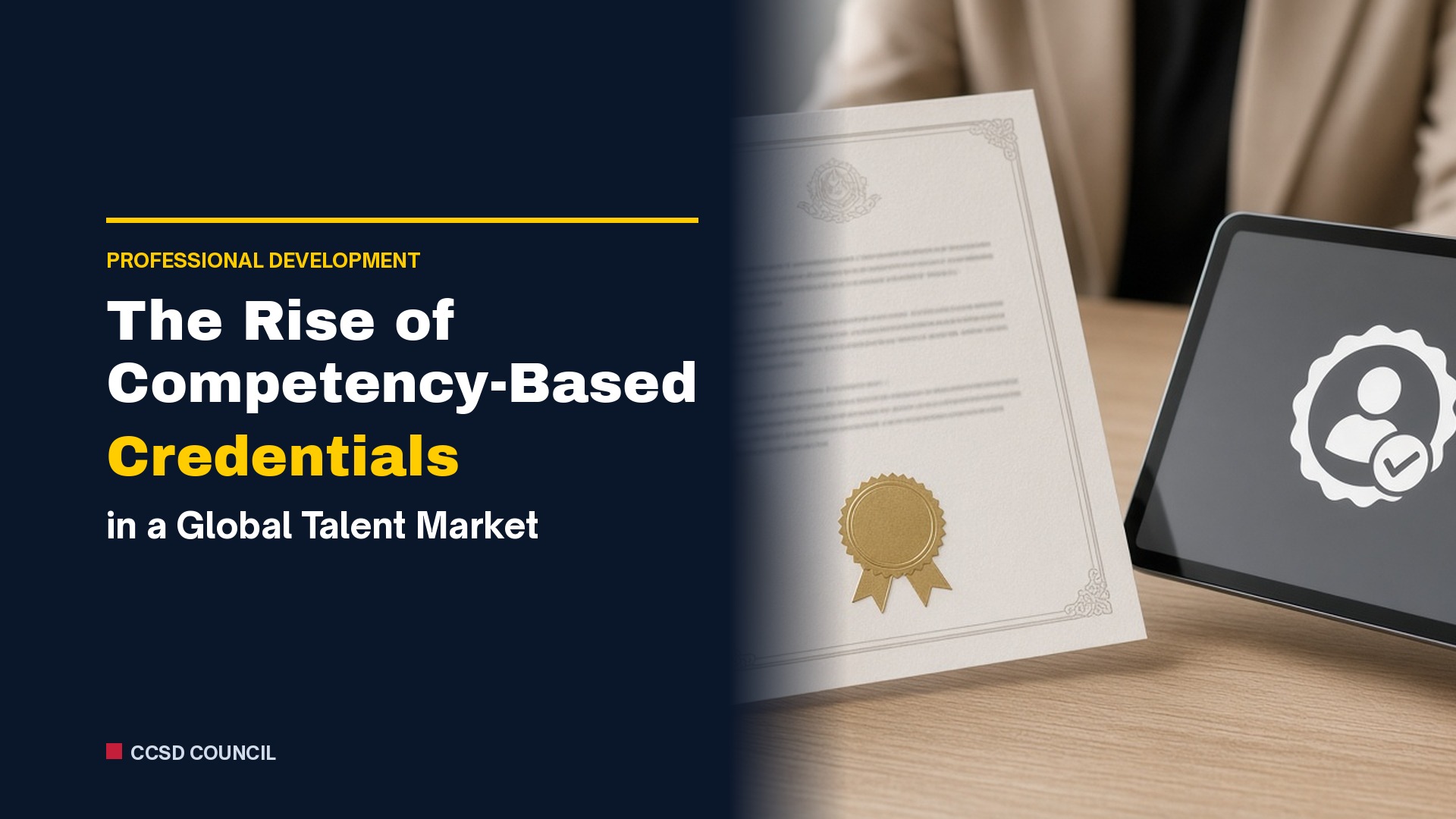
The Rise of Competency-Based Credentials in a Global Talent Market

Skills-based hiring is now widely discussed, but turning it into practice depends on something less visible: credentials that show, in a verifiable and portable way, what a person can actually do. Evidence from the World Economic Forum, the ILO, UNESCO, the European Union and Harvard Business School shows where competency-based credentials add value, and where quality assurance decides whether they are trusted.
Introduction: From “Where Did You Study?” to “What Can You Do?”
For most of the last century, the degree was the main signal in hiring. It was a reasonable proxy: it showed sustained effort, a baseline of knowledge and the endorsement of an institution. But a degree records what someone learned at one point in time. It says much less about which specific competencies they hold today, how they were assessed, or whether those skills are still current.
Two pressures are exposing this gap. Job requirements are changing faster than formal education cycles. At the same time, talent increasingly moves between employers, sectors and countries. When a hiring manager in one country reviews a candidate trained in another, a degree title alone rarely answers the practical question: can this person do the job to the required standard?
Competency-based credentials try to answer that question directly. At CCSD Council, we see them as an important complement to formal qualifications, not a replacement. Their value depends on how well they are designed, assessed and quality-assured.
What Is a Competency-Based Credential?
A competency-based credential certifies that a person has demonstrated defined skills or competencies against a published standard. The emphasis is on assessed performance, not time spent in a classroom. It may take the form of a professional certification, a micro-credential, a licence or an endorsed CPD award.
Credible competency-based credentials usually share five features:
- Defined learning outcomes: a clear statement of what the holder can do
- Valid assessment: evidence of performance, not just attendance or completion
- Independent quality assurance: review by a body other than the course provider
- Transparent level and workload: so the credential can be compared with others
- Verifiability: an employer can confirm it is genuine and current
Why Competency-Based Credentials Are Rising
Employers say they want direct evidence of skills
The World Economic Forum’s Future of Jobs Report 2025 asked employers how they expect to assess skills in hiring through 2030. Work experience remains the most common method (81%). Skills assessments come second (48%), and university degree requirements come third (43%). The WEF notes that, compared with its previous edition, employers are placing more emphasis on work experience and testing than on traditional credentials.
The same report identifies skills gaps as the main barrier to business transformation, cited by 63% of employers. It also observes that 14 of the 15 fastest-growing jobs to 2030 still primarily require a degree, and warns that relying on traditional credentials in fast-growing roles “could exacerbate talent shortages”.
Talent is more mobile than ever
The International Labour Organization estimates that there were 167.7 million international migrants in the global labour force in 2022, or 4.7% of the world’s workforce, an increase of more than 30 million since 2013. Every one of those workers brings skills that must be understood and recognised in a new labour market. When recognition fails, the result is often “brain waste”: qualified people working below their skill level.
Recognition frameworks are maturing
Governments are building the infrastructure for portability. UNESCO’s Global Convention on the Recognition of Qualifications concerning Higher Education, the first UN treaty on higher education, entered into force on 5 March 2023. As of July 2026, 42 States had ratified it. The Convention commits parties to fair, transparent and non-discriminatory recognition and includes provisions on recognising prior learning and non-traditional learning modes.
In Europe, the Council Recommendation of 16 June 2022 on a European approach to micro-credentials set out common standard elements that every micro-credential should describe. These include learning outcomes, notional workload, level, type of assessment, the awarding body and the type of quality assurance behind it. The Recommendation also states that micro-credentials should be owned by the learner and easy to store and share, for example through secure digital wallets such as Europass.
The Gap Between Pronouncement and Practice
Enthusiasm for skills-based hiring has run ahead of practice. A 2024 study by the Burning Glass Institute and Harvard Business School, Skills-Based Hiring: The Long Road from Pronouncements to Practice, examined 11,300 roles at large US firms that dropped degree requirements. Hiring of non-degree candidates into those roles rose by about 3.5 percentage points on average. Across all hiring, however, the change affected fewer than 1 in 700 hires, and nearly all the improvement came from 37% of the firms studied.
The lesson is not that skills-based hiring fails. Removing a degree filter from a job advert is not enough on its own. Employers also need reliable alternative evidence of competence. Without it, recruiters fall back on familiar proxies. Credible competency-based credentials can provide that evidence, but only if employers trust them.
Survey data suggests that trust is building where credentials are well aligned with industry. In Coursera’s Micro-Credentials Impact Report 2025, a provider-commissioned survey of more than 1,000 employers and 1,200 learners across six regions, 85% of employers said they were more likely to hire a candidate with a micro-credential. Because the survey comes from a credential provider, it is best read as a signal of employer sentiment rather than independent proof. The WEF data shows more caution: only 14% of employers plan to consider online certificates in hiring decisions. In practice, many employers value the idea of credentials but are unsure which ones to believe.
Quality Assurance: What Makes a Credential Travel
A credential’s portability depends less on where it was issued than on whether a stranger can understand and trust it. The European framework above points to four practical sources of trust:
- Transparency: clear, published learning outcomes, level and workload, ideally referenced to a national or regional qualifications framework.
- Rigorous assessment: performance-based evidence, with identity verification where the stakes justify it.
- External quality assurance: independent review of the provider and its internal processes, not only self-declaration.
- Verifiability: digital, tamper-resistant records that an employer anywhere can check.
Accreditation and endorsement by independent bodies are what move a credential from “a course someone completed” to “a standard someone met”. This is also why CPD records matter: they show that competence has been maintained, not just achieved once.
A Practical Framework: The CCSD Council Credential Credibility Check
Before investing in, or relying on, a competency-based credential, professionals and employers can ask five questions.
1. Is the competency clearly defined?
Look for published learning outcomes that describe observable capabilities, not just topics covered.
2. How was it assessed?
Prefer credentials that require demonstrated performance, such as practical tasks, case work, portfolios or supervised examinations, over completion-only certificates.
3. Who assures the quality?
Check whether an independent accreditation, endorsement or quality-assurance body reviews the provider and the standard.
4. Will it be understood elsewhere?
Check whether the credential states its level and workload and maps to a recognised qualifications framework or industry standard, so it can be read across borders and sectors.
5. Is it kept current?
Look for expiry or renewal requirements linked to structured CPD, especially in fast-changing fields.
For professionals: build a portfolio that pairs your formal qualifications with a small number of credible, assessed credentials in your target competencies, and keep the CPD record that shows they are current.
For employers: define the competencies each role actually requires, accept validated alternative evidence alongside degrees, and make your recognised credentials explicit in job descriptions and promotion criteria.
Conclusion
Competency-based credentials are rising because labour markets need a clearer, more portable language for skills. Degrees will remain important, and the evidence shows that most employers still use them. But in a global talent market, the most useful signal is a credible record of what a person can do, assessed against a clear standard, independently quality-assured and kept current through CPD.
The opportunity for professionals and employers is to be selective. A credential is only as valuable as the trust behind it. Investing in credentials that pass a basic credibility check is how skills-based hiring moves from statements to practice.
Selected References
- World Economic Forum (2025). The Future of Jobs Report 2025, Chapter 4: Workforce Strategies. https://www.weforum.org/publications/the-future-of-jobs-report-2025/in-full/4-workforce-strategies/
- International Labour Organization (2024). ILO Global Estimates on International Migrant Workers: International Migrants in the Labour Force, Fourth edition. https://www.ilo.org/resource/news/international-migrants-are-vital-force-global-labour-market
- UNESCO. Global Convention on the Recognition of Qualifications concerning Higher Education. https://www.unesco.org/en/higher-education/global-convention
- Council of the European Union (2022). Council Recommendation of 16 June 2022 on a European approach to micro-credentials for lifelong learning and employability (2022/C 243/02). https://eur-lex.europa.eu/legal-content/EN/TXT/?uri=CELEX%3A32022H0627%2802%29
- Sigelman, M., Fuller, J. and Martin, A. (2024). Skills-Based Hiring: The Long Road from Pronouncements to Practice. Burning Glass Institute and Harvard Business School. https://www.hbs.edu/faculty/Pages/item.aspx?num=65687
- Coursera (2025). Micro-Credentials Impact Report 2025. https://www.coursera.org/enterprise/resources/ebooks/micro-credentials-report-2025/