
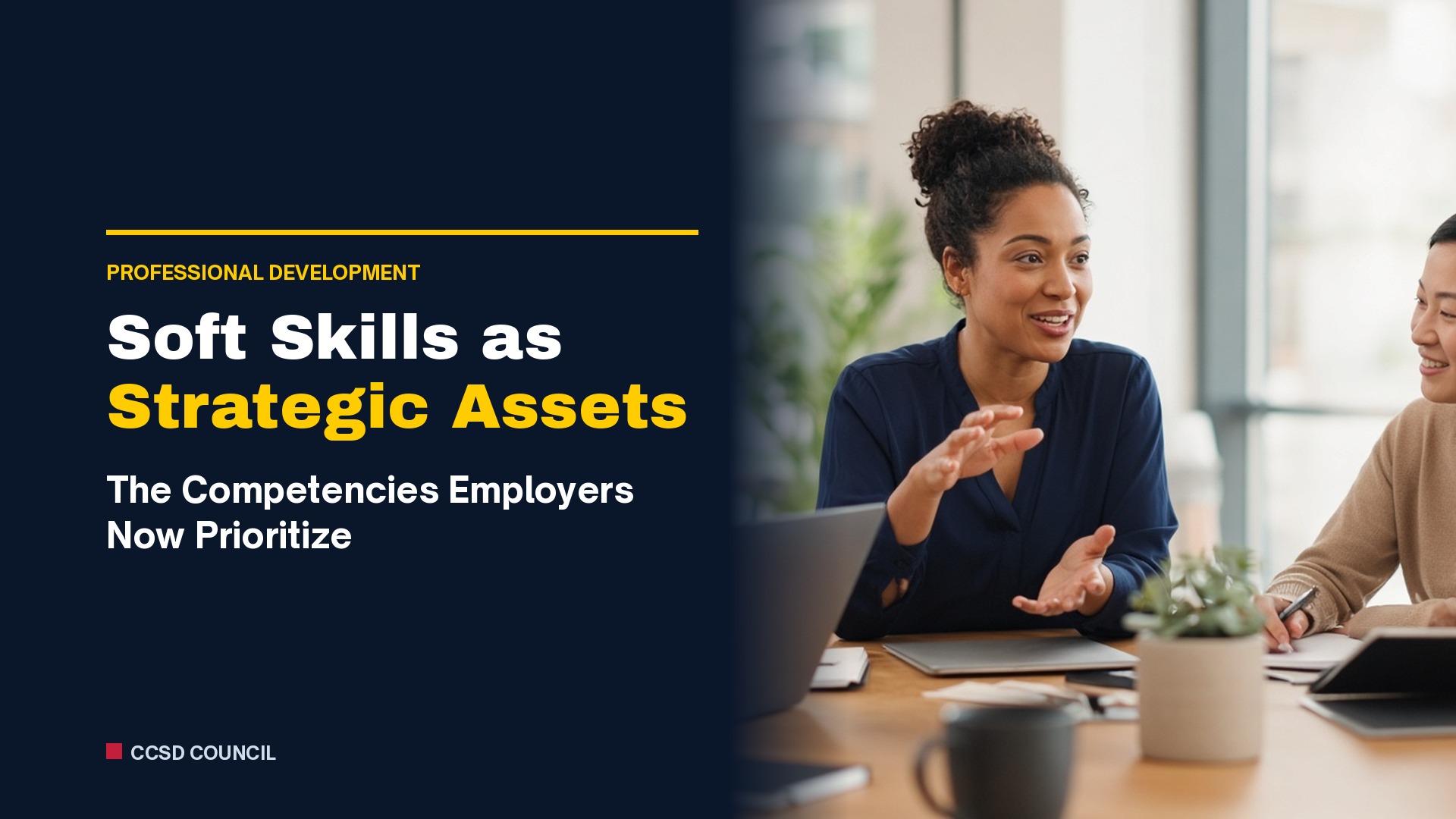
Soft Skills as Strategic Assets: The Competencies Employers Now Prioritize

Evidence from the World Economic Forum, LinkedIn, McKinsey and NACE suggests that human skills are now a core part of capability. They should be developed, evidenced and recognised with the same rigour as technical expertise.
Introduction: From “Nice to Have” to Core Capability
For years, “soft skills” sat at the edge of professional development. They were usually covered in an induction workshop or listed near the bottom of a job description. That is changing. As automation and AI take over more routine technical work, the skills that are hardest to automate (communicating clearly, working across teams, thinking critically, adapting to change and leading others) are becoming some of the most valuable things a professional brings to an organisation.
At CCSD Council, our view is that the term “soft” now undersells these skills. Employers treat them as strategic assets. They are linked to employability, promotion and organisational resilience, and they belong in a structured, evidence-based approach to continuous professional development (CPD).
What the Evidence Shows
Several major global studies agree that employers now value human skills alongside technical skills.
Employers rank human skills among their top core skills
The World Economic Forum’s Future of Jobs Report 2025, which surveyed more than 1,000 employers worldwide, found that analytical thinking remains the top core skill, with around seven in ten employers (69%) considering it essential. The next two were:
- Resilience, flexibility and agility: 67% of employers
- Leadership and social influence: 61% of employers
Creative thinking, motivation and self-awareness, and empathy and active listening also feature in the top ten. The report also notes that leadership and social influence saw the largest increase in importance of any skill since the 2023 edition, rising 22 percentage points.
Communication leads labour-market demand
LinkedIn’s analysis of its global member and job-posting data placed communication as the most in-demand skill of 2024, the second year in a row it held the top spot. Leadership, teamwork and problem-solving also appeared in the top ten, and adaptability was named the “skill of the moment” because demand for it grew fastest. LinkedIn also reports that 9 in 10 global executives agree that soft skills are more important than ever.
Human skills are linked to career outcomes
McKinsey’s research on future workforce skills identified 56 foundational “distinct elements of talent” across cognitive, digital, interpersonal and self-leadership categories. Respondents with higher proficiency in these elements were more likely to be employed, to earn higher incomes and to report higher job satisfaction. Employment was most strongly associated with self-leadership attributes such as adaptability and coping with uncertainty.
There is a measurable readiness gap
Employers also see a gap between how important these skills are and how well candidates demonstrate them. In the National Association of Colleges and Employers (NACE) Job Outlook 2025 survey:
- 88.3% of employers said they look for evidence of problem-solving skills on a candidate’s résumé, and 81% look for the ability to work in a team.
- Employers rated communication as the most important career-readiness competency (4.57 out of 5) but rated recent graduates’ communication proficiency much lower (3.62 out of 5).
That gap is where structured professional development can make the biggest difference.
The Six Competencies Employers Prioritise
Based on these findings, CCSD Council identifies six competencies that consistently appear in employer priorities.
1. Communication
This means sharing ideas clearly across channels, audiences and formats, including hybrid and digital settings. It also covers written precision, active listening and the ability to turn complex information into a decision.
2. Collaboration
This means working well across functions, disciplines and cultures. As work becomes more project-based and interdependent, the ability to build trust and share ownership directly affects results.
3. Critical and Analytical Thinking
This means judging evidence, questioning assumptions and solving problems that have no ready-made answer. In an AI-assisted workplace, it also means critically checking machine-generated outputs before acting on them.
4. Adaptability and Resilience
This means staying effective through change, uncertainty and setbacks. Both WEF and LinkedIn data rank it among the fastest-rising priorities.
5. Leadership and Social Influence
This means motivating others, guiding change and shaping outcomes without relying only on formal authority. Increasingly, employers expect leadership at every level, not just from those with a management title.
6. Emotional Intelligence
This means self-awareness, empathy and the ability to manage relationships constructively. It supports how well the other five competencies work in practice.
Why Soft Skills Are a CPD Priority
Technical knowledge goes out of date quickly. WEF employers expect 39% of workers’ core skills to change by 2030. Human skills, by contrast, last longer and carry across roles. They stay valuable through job changes, sector moves and technology shifts. For that reason, CCSD Council recommends that soft skills be:
- Planned: included in individual development plans, not left to chance
- Practised: built through realistic application, feedback and reflection
- Evidenced: recorded in CPD logs with concrete examples and outcomes
- Recognised: validated through accredited learning that employers can trust
Accredited CPD gives a standard way to show these capabilities. A professional who can point to structured learning, applied practice and reflective evidence presents a much stronger case than one who simply lists “good communicator” on a CV.
A Practical Framework: Building Soft Skills Through CPD
CCSD Council suggests a four-stage cycle for professionals and organisations.
Stage 1: Assess
- Use self-assessment, 360-degree feedback or manager input to find your strongest and weakest competencies.
- Compare your gaps with the requirements of your current role and your next one.
Stage 2: Learn
- Choose accredited, structured learning in one or two priority competencies at a time.
- Combine formal courses with mentoring, peer learning and guided reading.
Stage 3: Apply
- Look for “stretch” opportunities such as leading a meeting, presenting to senior stakeholders, mediating a disagreement or managing a cross-team project.
- Treat everyday work as practice, with clear intentions set beforehand.
Stage 4: Reflect and Record
- Write down what happened, what you did, what changed and what you would do differently.
- Keep this reflection in your CPD record as evidence of growth over time.
For employers
- Include human skills in competency frameworks, job descriptions and performance reviews.
- Fund accredited development for these competencies alongside technical training.
- Measure outcomes such as team effectiveness, retention, stakeholder feedback and internal mobility.
Key Takeaways
- Soft skills are now core capabilities. Global employer surveys rank them next to, and often above, many technical skills.
- Demand is rising. Leadership, adaptability and communication are among the fastest-growing priorities.
- There is a gap. Employers consistently rate these skills as more important than the proficiency they see in candidates.
- These skills can be developed. With structured, accredited CPD they can be built, evidenced and recognised.
Conclusion
Technical expertise still matters. But as technology changes what work involves, the professionals and organisations that do best will be those that invest just as seriously in human capability. Communication, collaboration, critical thinking, adaptability, leadership and emotional intelligence are not extras. They are strategic assets that support career longevity and organisational performance.
CCSD Council encourages professionals to make these competencies a deliberate part of their CPD plans, and encourages employers to recognise and reward them through structured, accredited development.
Selected References
- World Economic Forum (2025). The Future of Jobs Report 2025, Chapter 3: Skills Outlook. https://www.weforum.org/publications/the-future-of-jobs-report-2025/
- LinkedIn (2024). The Most In-Demand Skills of 2024. LinkedIn Talent Blog. https://www.linkedin.com/business/talent/blog/talent-strategy/linkedin-most-in-demand-hard-and-soft-skills
- McKinsey & Company (2021). Defining the skills citizens will need in the future world of work. https://www.mckinsey.com/industries/public-sector/our-insights/defining-the-skills-citizens-will-need-in-the-future-world-of-work
- National Association of Colleges and Employers (2025). Job Outlook 2025. https://www.naceweb.org/research/reports/job-outlook/2025